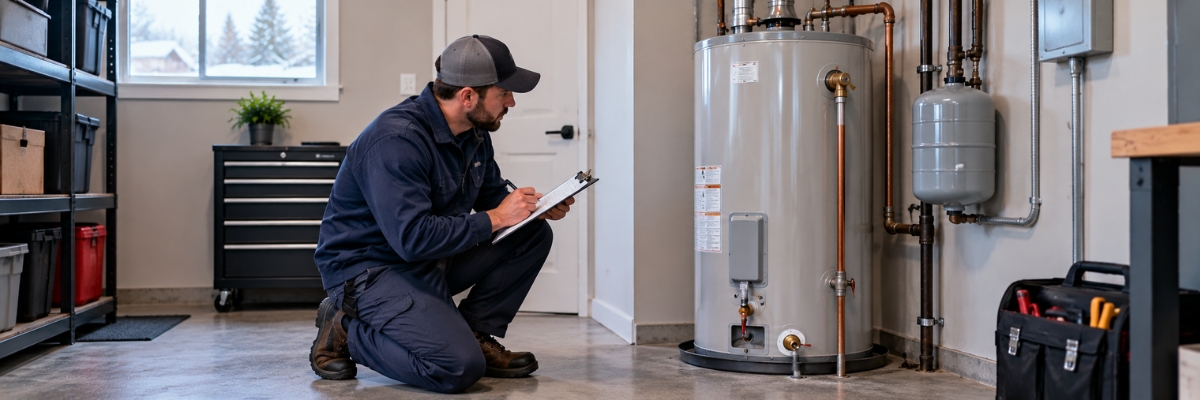

When replacing a water heater, homeowners often have two broad options to consider: a conventional storage-tank water heater or a tankless water heater.
Neither option is automatically better for every home.
Storage and tankless systems heat water differently, have different installation requirements and can suit different household priorities.
Understanding the basic differences can help you have a more productive conversation with your plumber before choosing a system.
How Does a Tank Water Heater Work?
A conventional storage water heater heats and stores a set amount of hot water in a tank.
When someone turns on a hot-water fixture, heated water is drawn from that stored supply.
The system then heats replacement water so it is available for future use.
Storage water heaters are common and relatively straightforward, but the amount of hot water immediately available is affected by the capacity and recovery of the system.
How Does a Tankless Water Heater Work?
A tankless water heater does not store a large tank of heated water.
Instead, it heats water as it passes through the unit when hot water is required.
This changes how the system is sized and installed.
Tankless does not mean unlimited hot water under every possible condition. The unit still needs to be capable of meeting the flow and temperature demands placed on it.
Proper sizing is therefore important.
Hot-Water Capacity
One of the most noticeable differences between the systems is how hot water is delivered.
A storage system has a tank containing heated water ready for use.
If demand exceeds the available stored hot water and recovery capacity, users may eventually experience cooler water until the system catches up.
A properly selected tankless unit continuously heats water as it flows through the equipment, but it also has maximum operating capacity.
If too many fixtures require hot water simultaneously, the demand may exceed what a particular unit can supply.
Installation Requirements
Do not assume that switching from a tank to tankless is simply a matter of removing one unit and connecting the other.
Installation requirements depend on the home and equipment.
A tankless conversion may require consideration of:
- Fuel supply
- Gas-line capacity where applicable
- Electrical requirements
- Venting
- Water connections
- Location
- Household hot-water demand
The existing home should be evaluated before deciding whether a tankless conversion is practical.
Space
Tankless water heaters are generally much smaller than conventional storage tanks.
For homeowners with limited mechanical-room or utility-space availability, this can be attractive.
However, available wall space alone should not determine the decision.
The required utility connections and installation conditions also matter.
Energy Use
Storage water heaters maintain a supply of heated water, while tankless systems heat water as it is needed.
That difference can affect energy use.
However, actual energy consumption depends on the equipment, fuel source, household hot-water use, efficiency and installation.
When comparing systems, look at the specifications of the actual equipment being considered rather than assuming every tankless unit will produce the same savings.
Initial Cost
Purchase price is only part of the cost of installing a water heater.
A straightforward replacement of an existing storage tank may involve fewer changes than converting the home to a tankless system.
A tankless installation may involve additional work depending on the existing gas, electrical, venting and plumbing setup.
Before choosing based on equipment price alone, consider the complete installed cost.
Maintenance
Both types of water heaters should be maintained according to the equipment manufacturer’s recommendations.
Maintenance requirements can vary depending on the model, water conditions and installation.
Homeowners considering a new system should ask what ongoing maintenance is recommended and factor that into the ownership decision.
Which Is Better for a Larger Household?
Household size alone does not determine the answer.
What matters is hot-water demand.
Consider how many hot-water fixtures may operate at the same time.
For example, a household may sometimes have:
- Multiple showers operating
- A dishwasher running
- Laundry being washed
- Kitchen hot water being used
The system needs to be selected with realistic peak demand in mind.
Which One Should You Choose?
Start with your household rather than the technology.
Consider:
- Current hot-water usage
- Peak hot-water demand
- Available space
- Existing utilities
- Fuel source
- Installation requirements
- Budget
- Maintenance expectations
- How long you expect to remain in the home
If you’re already deciding whether to replace an existing unit, our guide to water heater repair vs replacement can help you evaluate whether replacement is appropriate before choosing the next system.
Choosing a Water Heater in Kamloops
Stillwater Plumbing & Heating installs conventional and tankless water heaters and can assess the home’s existing plumbing and utility setup. The company’s website also identifies Bradford White, John Wood and Navien among the water-heating brands it works with.
If you’re considering a new system, Stillwater provides Kamloops water heater installation and can help determine which type of equipment is appropriate for your property.
Call (250) 819-8247 to discuss your water-heating needs.
Frequently Asked Questions
Not necessarily. Both can be appropriate depending on the home, hot-water demand, existing utilities, installation requirements and budget.
A tankless system can continue heating water while it is operating, but every unit has capacity limitations. It needs to be properly sized for the household’s expected flow and temperature requirements.
Potentially, but the home should first be evaluated for factors such as fuel supply, venting, electrical requirements and hot-water demand.
Tankless units are generally more compact than storage tanks, although installation requirements still need to be considered.
Sizing depends on the type of system and the household’s hot-water requirements. A professional can evaluate usage and peak demand before recommending equipment.

Why Is My Water Heater Not Producing Enough Hot Water?