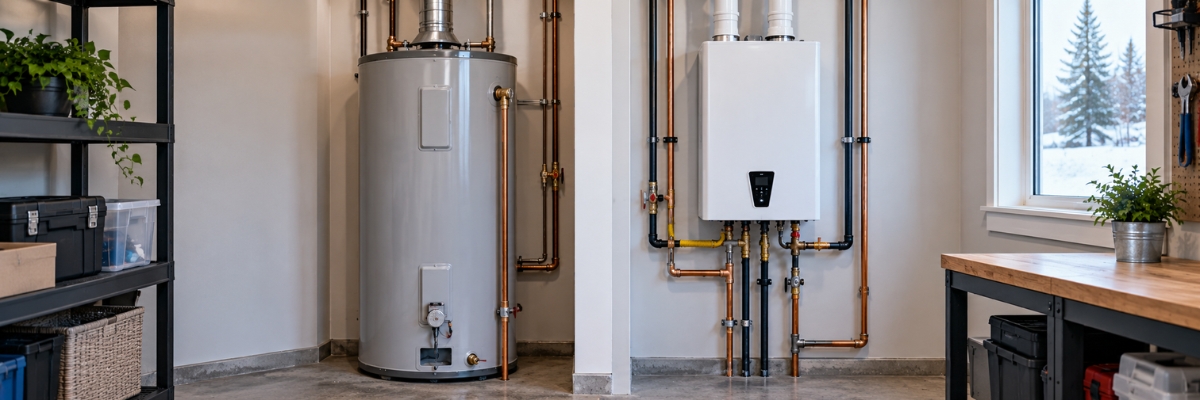

When a water heater develops a problem, replacing the entire unit is not always necessary. A repair may restore reliable hot water and allow the equipment to continue operating for years.
At other times, putting more money into an older or deteriorating water heater may only delay an inevitable replacement.
The right decision depends on more than one factor. Homeowners should consider the nature of the problem, the age and condition of the equipment, its repair history and how well it meets the household’s needs.
Start With the Actual Problem
Before deciding between repair and replacement, determine what is wrong.
Symptoms such as insufficient hot water, unusual noises or water around the equipment do not identify the cause by themselves.A
professional assessment can help determine which component has failed and whether the problem can reasonably be repaired.
Avoid making a replacement decision based solely on a symptom.
When Repair May Make Sense
Repair may be a reasonable choice when the problem is isolated and the water heater is otherwise in good condition.
Factors supporting repair may include:
- The unit has generally been reliable
- The problem is associated with a repairable component
- There is no evidence that the tank itself is leaking
- The equipment still meets the household’s hot-water needs
- The water heater has not required repeated repairs
The cost and complexity of the required repair should also be considered.
When Replacement May Make More Sense
Replacement becomes more worth considering when several problems begin occurring together.
Examples can include:
- Repeated repairs
- Declining reliability
- Visible deterioration
- A leaking tank
- Poor hot-water performance
- Equipment that no longer meets household needs
Our guide to the signs your water heater needs to be replaced covers these warning signs in more detail.
Consider the Age of the Water Heater
Age provides useful context, but it should not make the decision by itself.
Two water heaters of the same age may be in very different condition.
Consider age alongside:
- Maintenance history
- Condition
- Repair history
- Performance
- Type of water heater
- Installation
- Household usage
The question is not simply “How old is it?” but “What condition is it in, and does repairing it still make sense?”
Look at the Repair History
A water heater that has been reliable for years and develops one repairable problem is very different from a unit that has required repeated service.
Keep track of repairs.
If several components have required attention within a relatively short period, consider whether continuing to repair the unit represents good long-term value.
Is the Tank Itself Leaking?
Finding water around a water heater does not automatically mean the tank has failed.
The source needs to be identified.
Water may originate from a connection, valve or another component associated with the system.
If the tank itself is leaking because it has deteriorated, however, replacement is generally a much more likely outcome.
Does the Water Heater Still Meet Your Needs?
The condition of the equipment is only part of the decision.
Consider whether it still provides enough hot water for your household.
Hot-water requirements can change because of:
- More people living in the home
- Changes in bathing habits
- New fixtures
- Renovations
- Changes to appliances or household routines
If you are already considering a replacement, it is a good opportunity to make sure the next system is appropriately suited to the home.
Consider Your Water Heater Options
Replacing an existing water heater does not necessarily mean installing exactly the same type or size.
Depending on the home, fuel source and hot-water requirements, homeowners may consider conventional storage water heaters or tankless systems.
Each has different installation requirements, characteristics and costs.
The best option depends on the property rather than assuming one technology is right for every household.
Think About Long-Term Value
The cheapest immediate option is not always the least expensive long-term decision.
An inexpensive repair may make sense on a reliable unit with an isolated problem.
Repeatedly repairing an aging system with declining reliability may not.
Compare:
- Current repair cost
- Previous repair history
- Condition of the equipment
- Expected reliability
- Replacement cost
- Whether the existing system meets your needs
A plumber can provide information about the condition of the system so you can make a more informed decision.
Water Heater Repair and Installation in Kamloops
Stillwater Plumbing & Heating provides water heater repair and installation in Kamloops for homeowners who are experiencing problems with their hot-water systems.
Rather than automatically assuming the unit needs replacement, the first step is identifying the problem and assessing the condition of the equipment.
Call (250) 819-8247 to arrange an assessment of your water heater.
Frequently Asked Questions
It can be. If the problem is repairable and the equipment is otherwise in good condition, repair may be a practical choice.
Replacement may make more sense when the tank is leaking, reliability is declining, repairs are becoming frequent or the existing system no longer meets the household’s needs.
No. Age is useful information, but condition, performance and repair history should also be considered.
It depends on where the leak originates. Some connections or components may be repairable. A leaking tank is a different situation and should be professionally assessed.
Not necessarily. Replacement provides an opportunity to evaluate the home’s current hot-water requirements and available water-heating options.